Searching for fragments of history, in Votiaia

Research & Article by Dimosthenis Seitaridis
Cover photo by Dimosthenis Seitaridis
Edited by Harrys Pourouzidis

It is no small thing, in your fourties, to find people along your path who share the same interests as you. It is an even greater thing, at that age, to find real friends who do not mind setting off with you before sunrise, cameras at the ready, in search of mythical places that lie beyond the tourist map.

Feeling very lucky, then, to have my tireless companions Nikos, Danis, and Giorgos by my side, we set out before dawn on a winter Sunday, with the sound of Markos Vamvakaris blasting in the car speakers, for a short journey into ancient Bottiaea.

Bottiaea, Bottia, or Bottiaïs was the third region to be incorporated into the Macedonian kingdom. It formed part of the ancient land of Emathia, which stretched between the Axios and Loudias rivers and reached as far as today’s Mount Paiko. It included the entire marshy plain between the two rivers, the area around the former Lake of Giannitsa.

Historic cities of Bottiaea included Aloros, Pella, Atalanti, Gortynia, Kyrros, Mieza, Ichnae, Edessa, Skydra, and others. Strabo records a tradition of his time according to which Cretans took possession of the area and were called Bottiaeans after their founder, Botton.

The ancient Greeks of the Hellenistic period knew the even older myth of the Minotaur and the tribute paid by the Athenians to Minos. According to the myth, the Athenians, angered by the victory of Minos’s son Androgeos, who had taken part in Athenian games and was preparing to return victorious to his island, killed him. Enraged by the unjust death of his son, Minos waged war against the Athenians, defeated them, and imposed a strange and unheard-of tribute: every year they were to send to Crete seven young men and seven young women, chosen by lot, to be thrown to the Minotaur as food. In reality, according to another version, they were not killed but kept as slaves.

Descendants of those Athenian slaves, led by a notable and capable Cretan named Botton, set sail from the great island. After wandering the seas, they reached the Ambracian Gulf, on the coasts of today’s Arta and Preveza. From there, crossing the mountains of Epirus in search of a new homeland, they settled in the land between the Axios and Loudias rivers, which took the name Bottiaea from their leader. What is curious is that this version has been accepted by modern researchers such as N. Hammond, on the basis of relevant archaeological finds, since similar grave goods have been discovered in both Crete and Bottiaea.

- The Medieval Bogomil Cemetery — Nea Chalkidona -

Our first stop was Chalkidona, a place most people pass by without a second thought. A great mistake. At the entrance of the town, hidden among the fields, lies an archaeological treasure: the medieval cemetery of the Bogomils. 

To begin with, the area itself has a long history. In the years of the Macedonian kingdom, the city of Ichnae stood here, one of the most important and largest commercial centres of Macedonia, as well as a significant mint and port.

During the Byzantine period, Chalkidona was an inhabited area where the Byzantine emperors had settled the Bogomils, hence their cemetery. The Bogomils continued to live in the region during the period of Ottoman rule, from 1430 onwards. At that time, Chalkidona was called Yaletzik, and those Bogomils who had survived the persecutions of the Byzantines were forced to adopt Islam. Yet, in a remarkable way, they preserved the cemetery of their ancestors. But who were the Bogomils?

The Bogomils were not a tribe or a nation. They were followers of what they themselves regarded as a Christian doctrine or, in the eyes of the Patriarch of Constantinople and the Pope of Rome, one of the worst heresies. Political rulers held much the same view as the religious authorities, since the Bogomils were, in a sense, the first anarchists. They stubbornly refused to bow before human beings and did not accept that any person could, by divine right, exercise authority over another.

The roots of Bogomilism lie in the tenth century, in Philippopolis, today’s Plovdiv in Bulgaria. There, Emperor Constantine V had forcibly settled the Paulicians of Asia Minor, another religious sect. In Philippopolis, a priest named Jeremiah appeared and began preaching in favour of a Christian doctrine with several dogmatic differences from both the Eastern and Western Churches.

The Bogomils took their name from the Bulgarian monk Philotheos, Bogomil in Slavonic, meaning “friend of God”, who spread the new doctrine among the common people. They believed only in the Gospels of Luke and John, and, naturally, in the Letters of Paul, since they were connected to the older Paulician tradition.

According to their doctrine, God had two sons: the elder, Satanael, inventor of matter and evil, who ruled over the earth; and the younger, Christ, the good spiritual leader who dwells with God in heaven. They believed only in the power of the spirit and rejected matter, which they considered the creation of Satanael.

They performed no sacraments except baptism, and even that they practised without water, since water too is matter. They did not eat meat, drink alcohol, touch money, or venerate icons. Most importantly, they recognised no human authority, and therefore bowed before no emperor or high priest.

They called themselves “good Christians” and believed that the Orthodox, through the way they lived, were praising Satanael. They argued that one could not be bound to matter and power while also claiming to believe in God.

As was to be expected, with such troublesome beliefs, the Byzantine emperors persecuted the Bogomils with fire and sword. Emperor Alexios I Komnenos carried out the greatest persecutions; after capturing their leader, the monk Basil, he had him burned alive in the Hippodrome of Constantinople.

Despite persecution, the Bogomils survived for many decades, and in significant numbers, especially in what is now Bosnia, until the arrival of the Turks in the Balkans. At that point, most of them converted to Islam. Nevertheless, they preserved their cemeteries as they were, in order to honour their dead ancestors, who had been buried there according to the old doctrine.

- Museum of the Balkan Wars — Gefyra Settlement -

We left Chalkidona and its Bogomils behind and headed towards the settlement of Gefyra. There we saw what remains of the Modiano estate, which today houses the Museum of the Balkan Wars.

Before the First Balkan War, the museum’s main building was the mansion of the Modiano estate, created in 1906 by Yako Modiano. Yako’s father, Saul Modiano, was the second-largest landowner in the Ottoman Empire. During Ottoman rule, the settlement of Gefyra was called Topsin. As a result of these two facts, the mansion is sometimes referred to as Villa Modiano and sometimes as Villa Topsin. It was in this mansion that the General Headquarters of the Greek forces was established during the First Balkan War, on 24th October 1912, after arriving from Giannitsa and Adendro. It remained there until the early hours of 27th October.

Those three days proved decisive for the fate of Macedonia and for the outcome of the war more generally. In this mansion, intense negotiations took place between the Turkish delegation, led by the commander of the city, Hasan Tahsin Pasha, and the commander-in-chief of the Greek forces, Crown Prince Constantine. During the First Balkan War, Hasan Tahsin was commander of the 8th Army of the Imperial Ottoman Army in Macedonia. After the Greek army captured the Sarantaporo passes, the Ottoman army withdrew to Giannitsa, where it fought a defensive battle in an attempt to stop the Greek advance towards Thessaloniki. 

After two unsuccessful attempts to reach an agreement, the Turks returned to the building at noon on 26th October 1912, the name day of Saint Demetrios, patron saint of Thessaloniki. They announced that Tahsin Pasha had agreed to surrender the city of Thessaloniki unconditionally, along with 25,000 prisoners, to the Greek army — an act for which he was later sentenced to death in absentia as a traitor.

As a graduate of the Zosimaia School of Ioannina, he had received a Greek education and held Greek culture in great esteem, a fact that contributed to his decision not to allow Thessaloniki to be handed over to the Bulgarians. Having fallen out of favour with the Turks, he later lived in Switzerland under the protection of the Greek state.

The tomb of Hasan Tahsin Pasha is located in the courtyard of the museum. The bones of his son and adjutant, Kenan Mesare, have also been placed in the same funerary monument.

Today, visitors to the museum have the opportunity to see not only the furnishings, household objects, and decoration of the mansion, but also a wealth of military relics from the Balkan Wars: uniforms, weapons, medals, and various other objects of the Greek Army. They can also see many relics from the Turkish, Bulgarian, and Romanian armies of the Balkan War period.

- Elli Dam — Axios River -

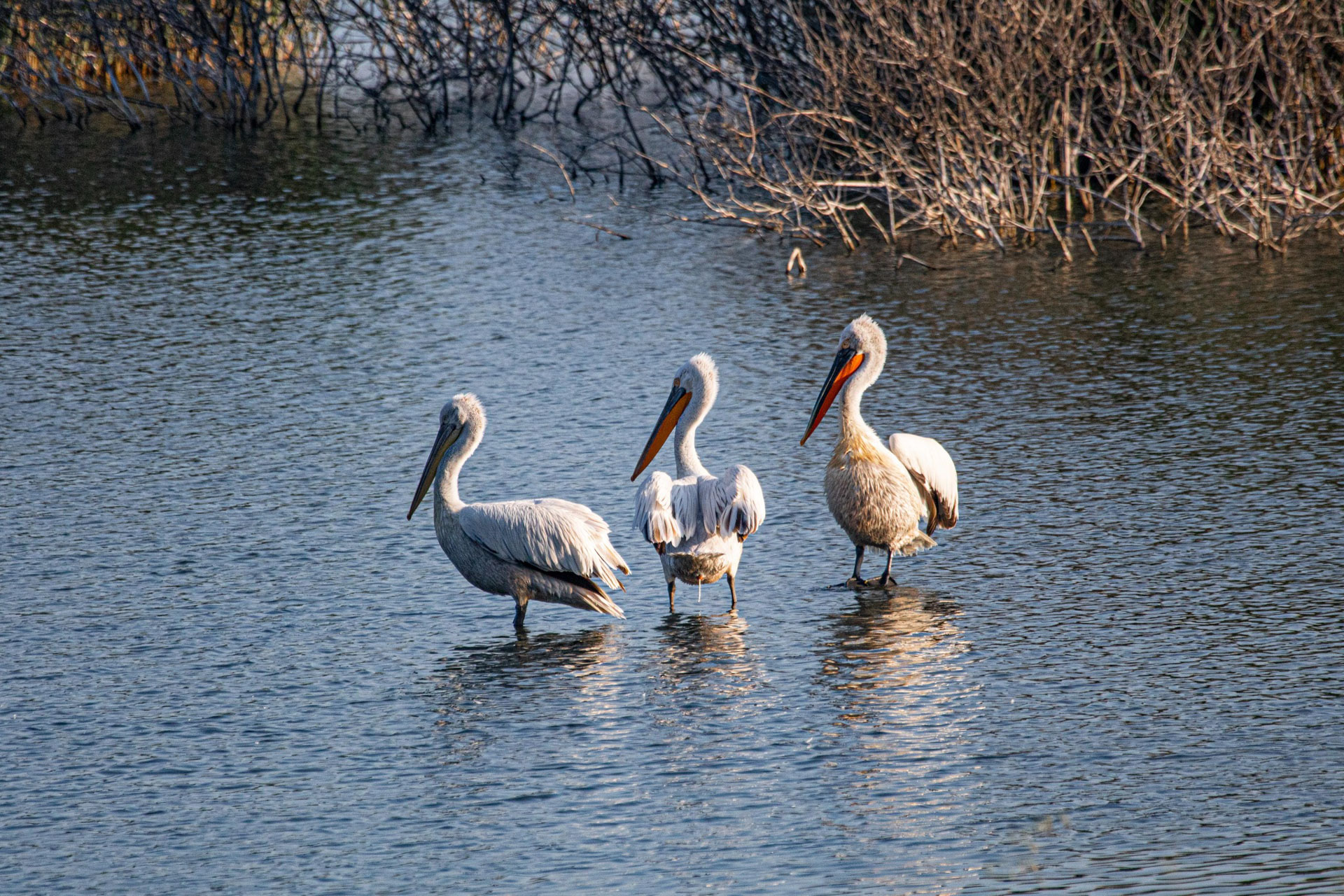
We left the excellent Museum of the Balkan Wars and headed towards the Axios River and the Elli Dam, hoping to photograph birds.

The dam is an irrigation project, 1,132 metres long, inaugurated in 1958. Since 2008, the small Eleousa hydroelectric station has operated at its western end. Its waters irrigate, through open canals, around 330,000 stremmata of agricultural land.

In the end, we did not photograph birds, but we did find a happy fisherman. It seemed to be his day, and his catch had gone particularly well.

- Ancient Pella -

The final stop of our Sunday outing was Pella, capital of the Kingdom of Macedonia.

The city was founded in the heart of Bottiaea by Archelaus I, who ruled from 413 to 399 BC, or perhaps by Amyntas III, in order to become the new capital of the Macedonian state in place of Aigai, today’s Vergina. Pella remained the capital until the Macedonian kingdom was overthrown by the Romans, who looted the city and carried its treasures to Rome.

The earliest reference we have of Pella comes from Herodotus, in his account of the Persian campaign, and from Thucydides, in his description of Macedonian expansion and the war against Sitalces, king of the Thracians.

According to Xenophon, at the beginning of the fourth century BC, Pella was the largest city in Macedonia. It attracted famous artists of the time, such as the painter Zeuxis, the poet Timotheus of Miletus, and Euripides, who died there while writing the tragedy Archelaus.

After the violent death of Archelaus, the development of both the kingdom and Pella was interrupted until the time of Philip II, who, through clever alliances, diplomacy, and victorious campaigns, expanded the Kingdom of Macedonia.

During those years, Pella reached its full glory. It became “the greatest of the cities in Macedonia,” as Xenophon wrote, and its influence spread throughout the known world through the conquests of Alexander III.

Our photo-walk through ancient Pella ended in the best possible way, with a visit to the wonderful new archaeological museum. It is a museum everyone should visit, as it serves as a point of reference for the history of ancient Macedonia, and especially for the emblematic capital of the Macedonian kingdom, where Alexander the Great was born and raised.

In the end, one does not need to spend a great deal of money or travel countless kilometres to tourist destinations in order to have a wonderful time.