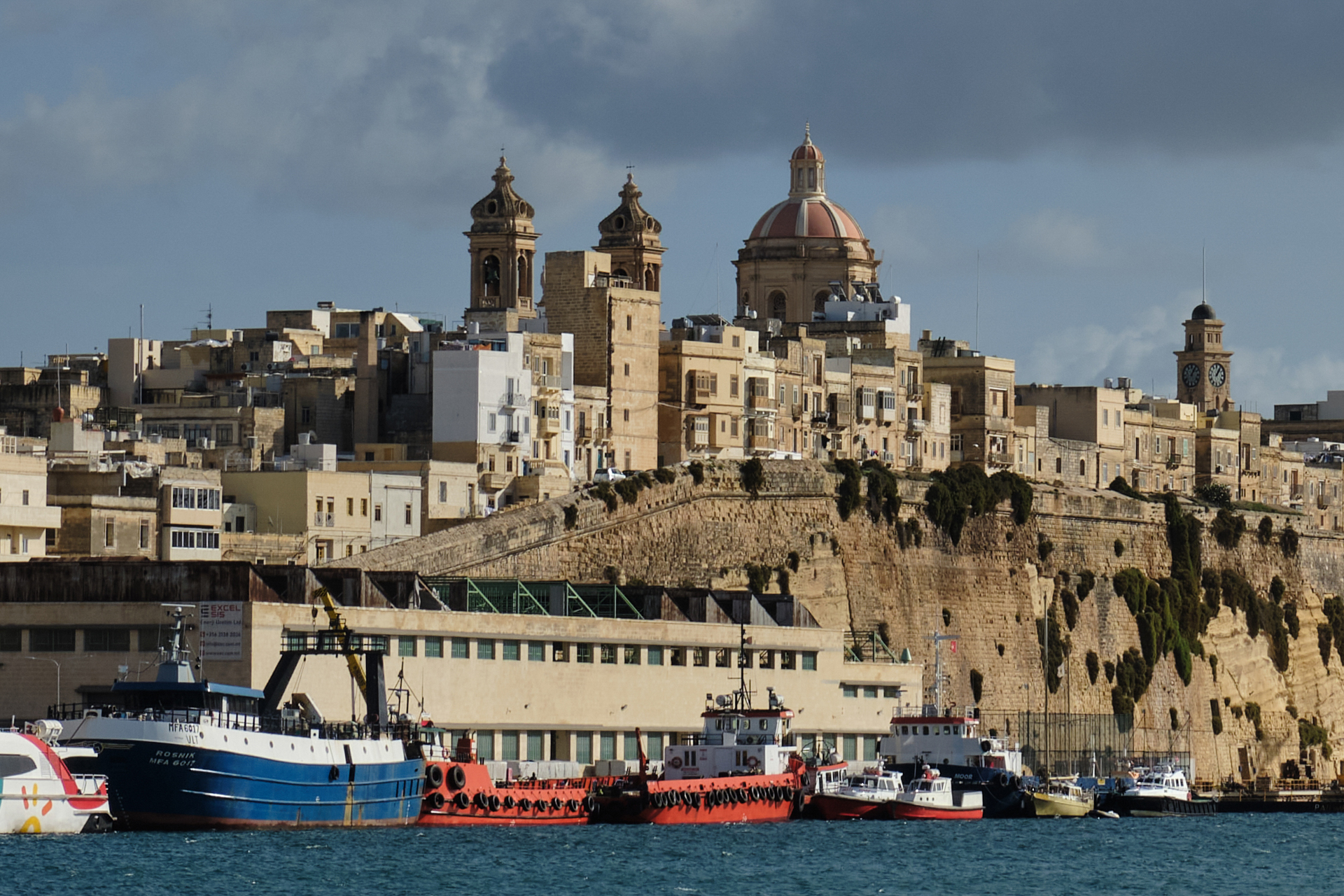
Cover photo by Dimosthenis Garatsidis
Article by Dimosthenis Garatsidis
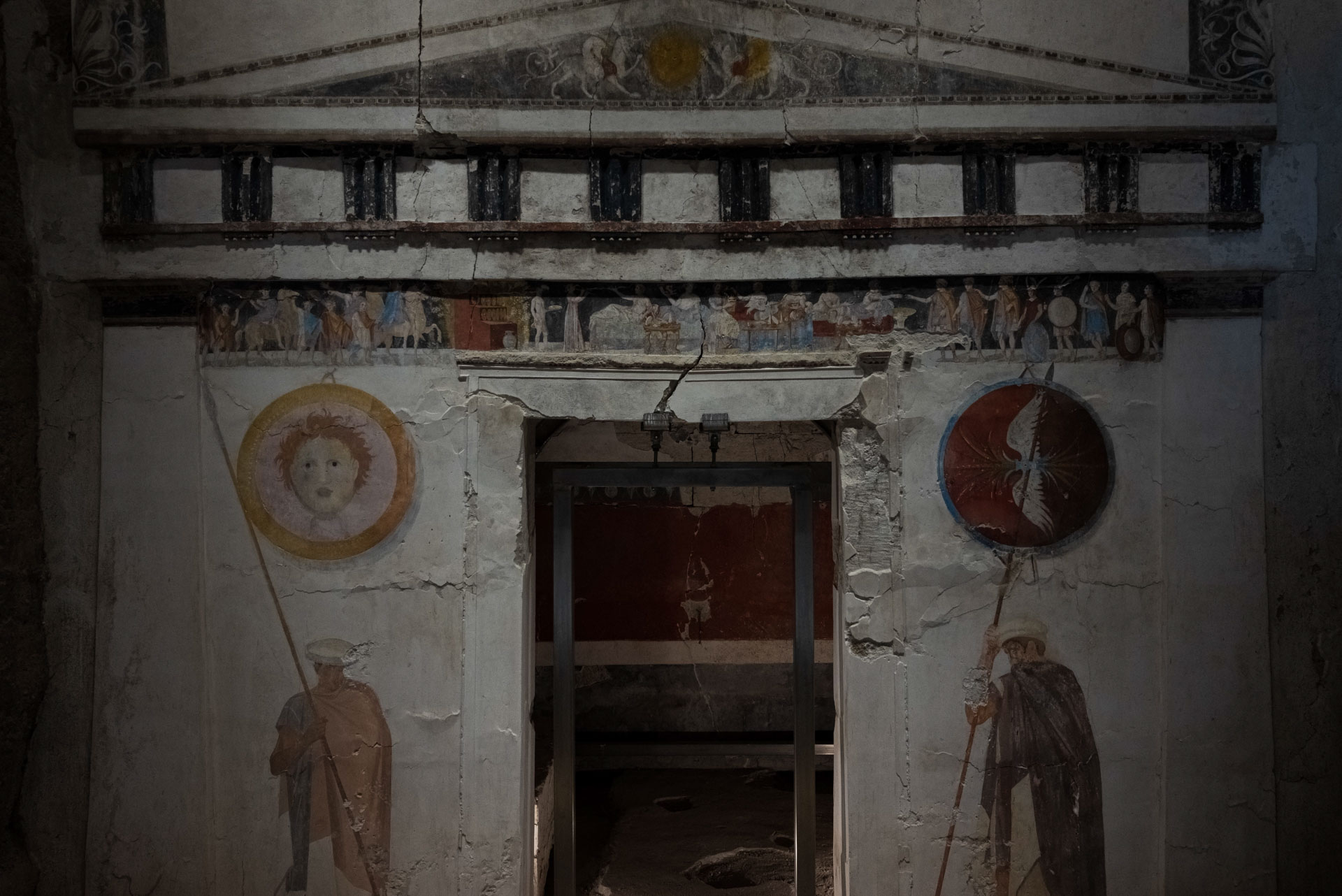
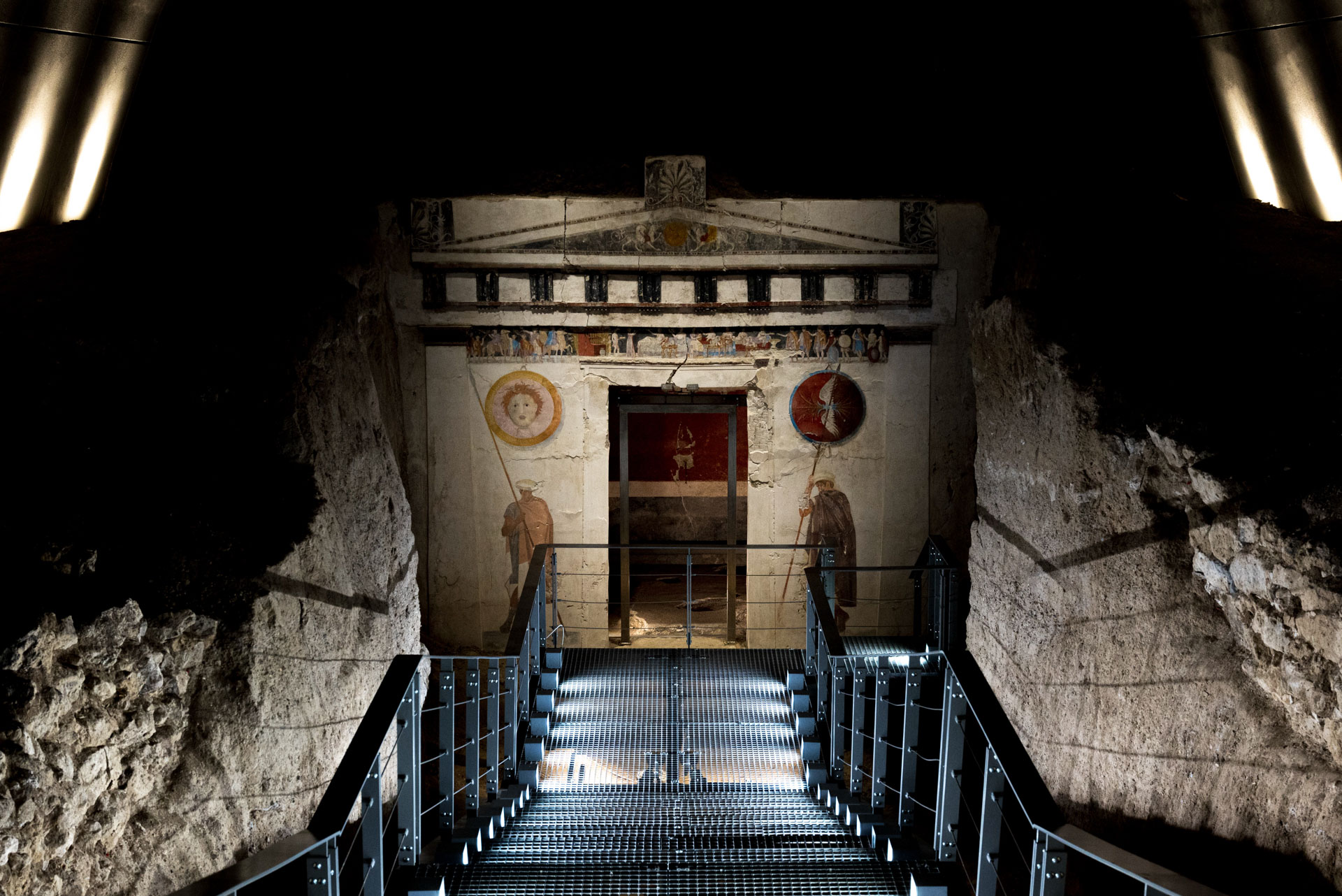
The fertile land of Macedonia holds many well-hidden secrets. One of them was uncovered in 1994, just outside Thessaloniki, in the village of Agios Athanasios. Archaeologist Maria Tsimpidou-Avloniti and her colleagues excavated a Macedonian tomb, which, unfortunately, had been looted since ancient times. Ηowever, the well-preserved frescoes on the façade tell us a great deal about life in ancient Greece. Following appropriate conservation and restoration work, the monument is now, thankfully, open to visitors. This particular single-chamber Macedonian tomb has a vaulted roof and a Doric-style façade.
In the majority of ancient Macedonian tombs, the central element is the deceased himself, as his social status, values, and virtues are highlighted. This is case also here where the findings suggest that the tomb most likely belonged to a royal consort and the fresco depicts his glorious military past.
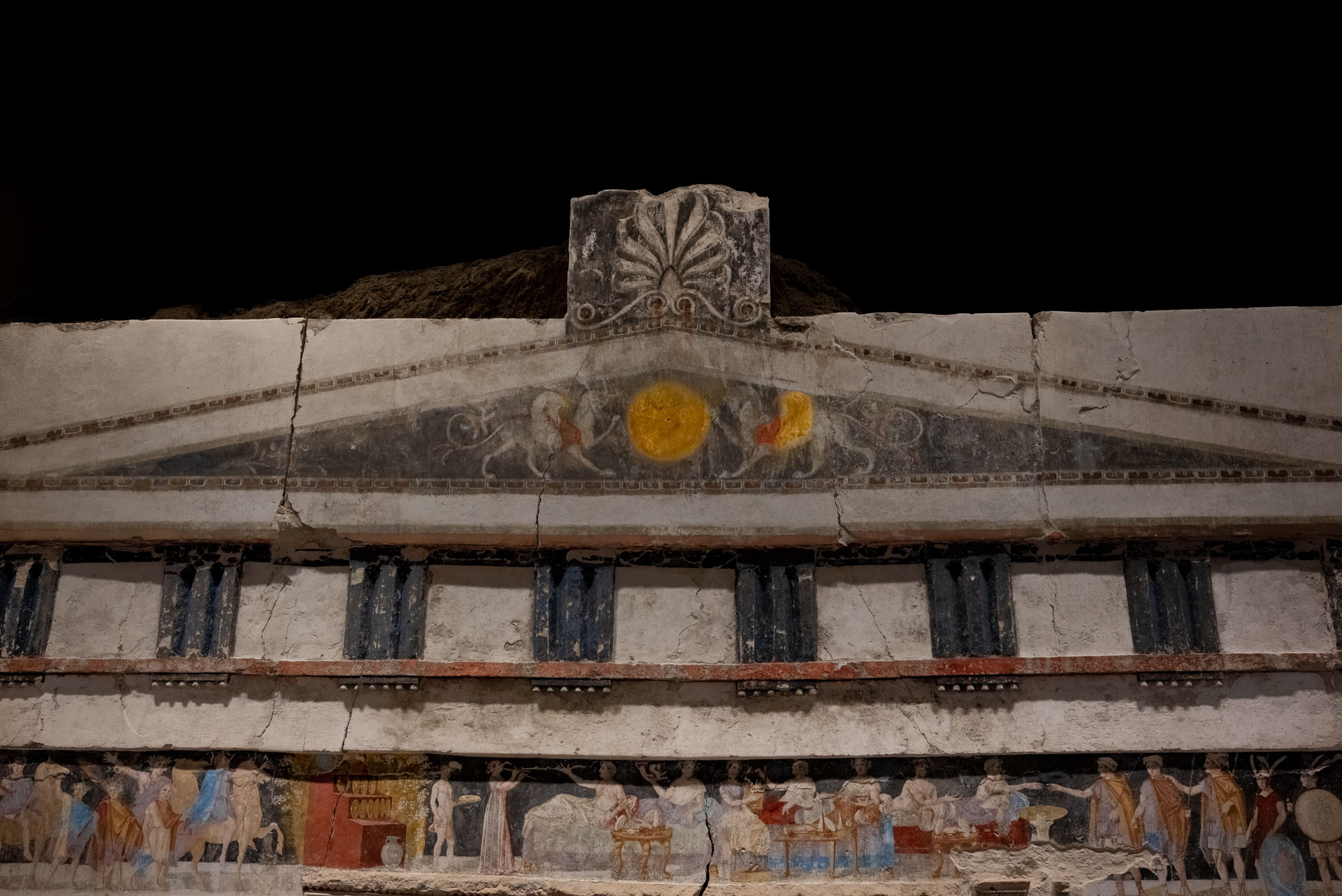
On the pediment is a golden disc, flanked by two griffins arranged in a heraldic manner.
“For Zeus’s sharp-mouthed, ferocious dogs, the griffins, guard you…”
– Aeschylus Prometheus Bound
The painted depiction of a banquet on the frieze is striking. An entire scene unfolds before our eyes; we see not just a moment, but a story.
On the left side of the mural, a group of young, cheerful horsemen and their foot attendants hold torches to see in the dark and jugs of wine, signaling their own participation in the banquet. They wear wreaths on their heads, suggesting that they are arriving from another banquet—specifically, the famous “komos.”
The banquet dominates the center of the image, likely taking place in the courtyard of the residence of a prominent
Macedonian, an officer and likely a comrade-in-arms of Alexander the Great. The guests are
equal companions of the host.
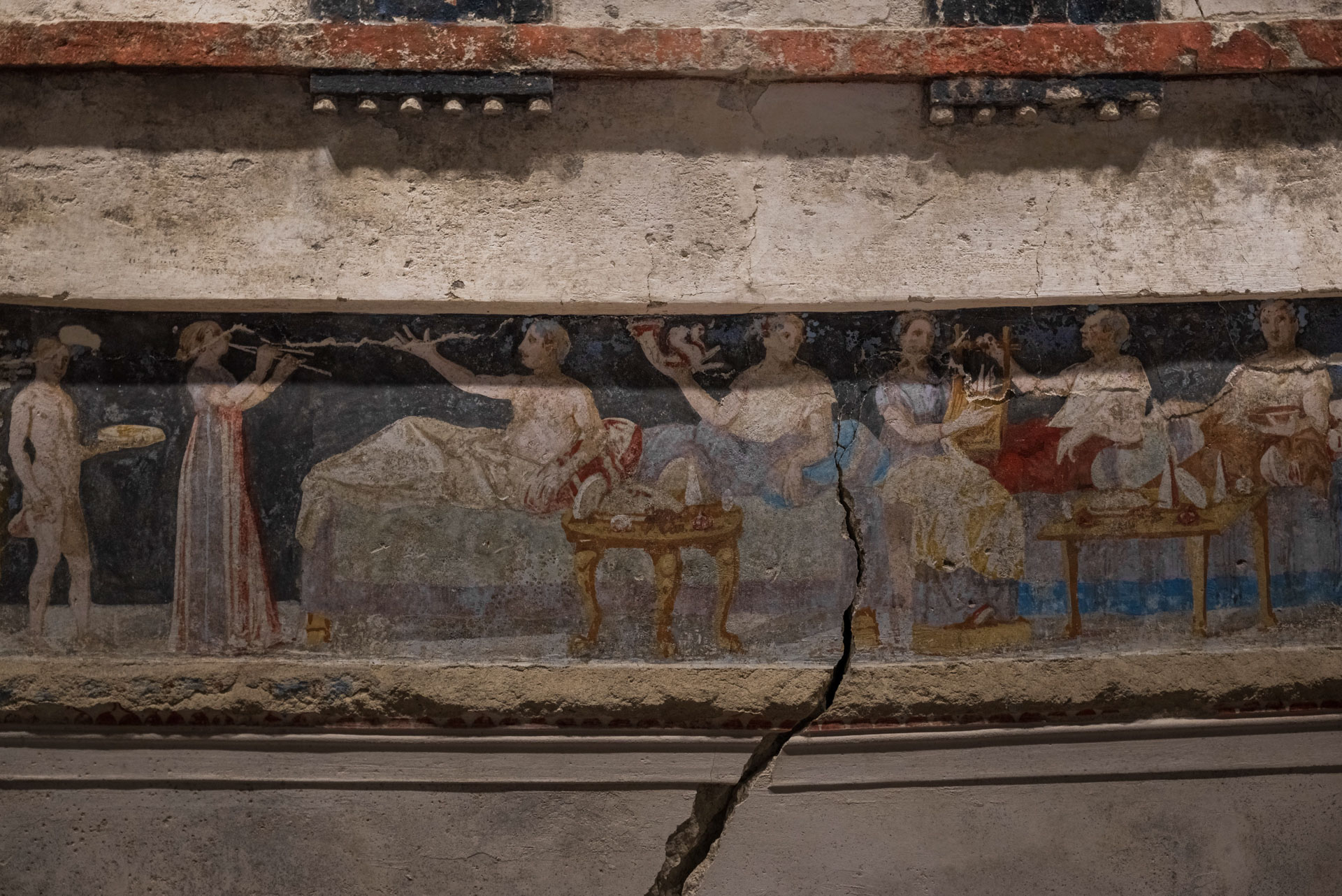
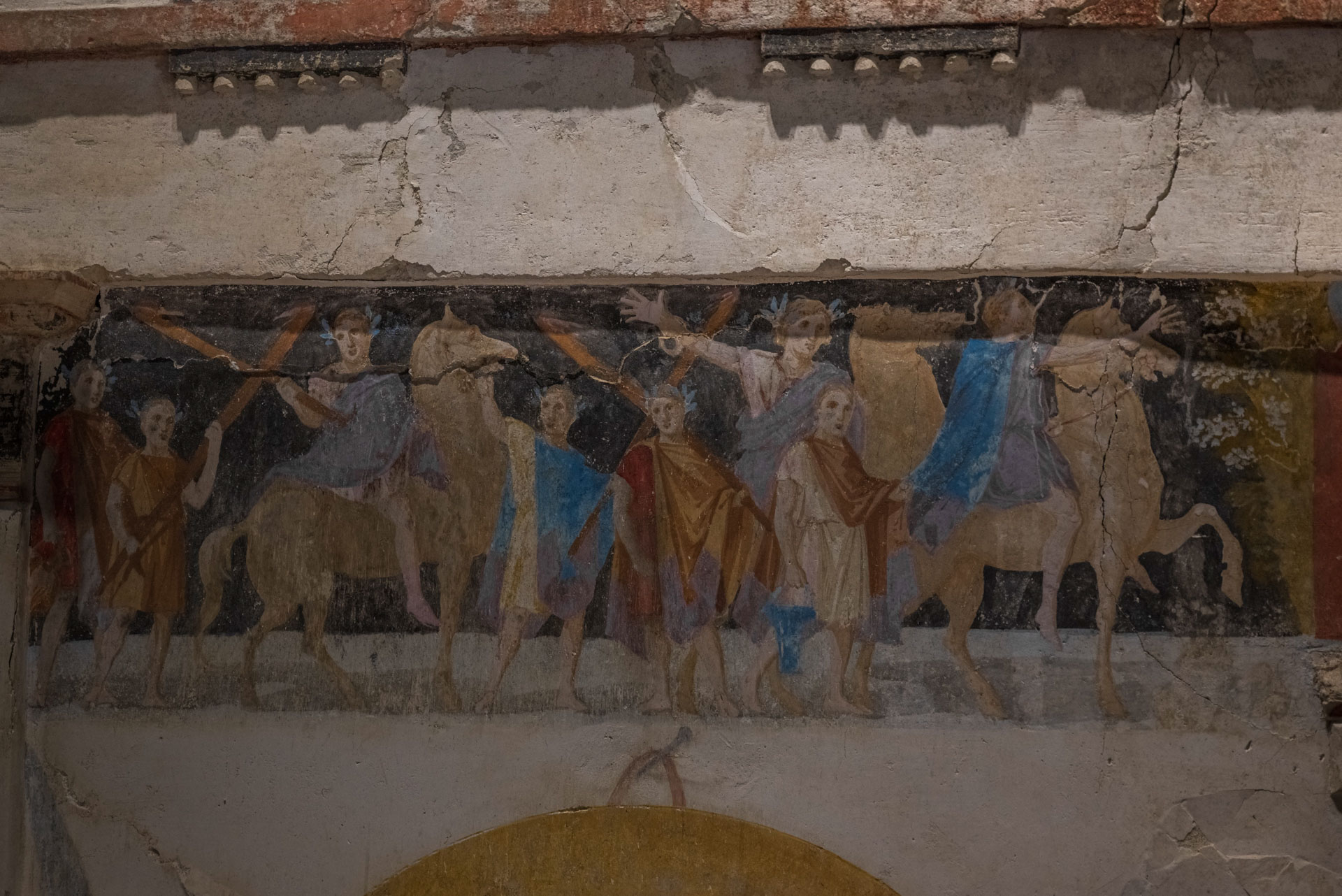
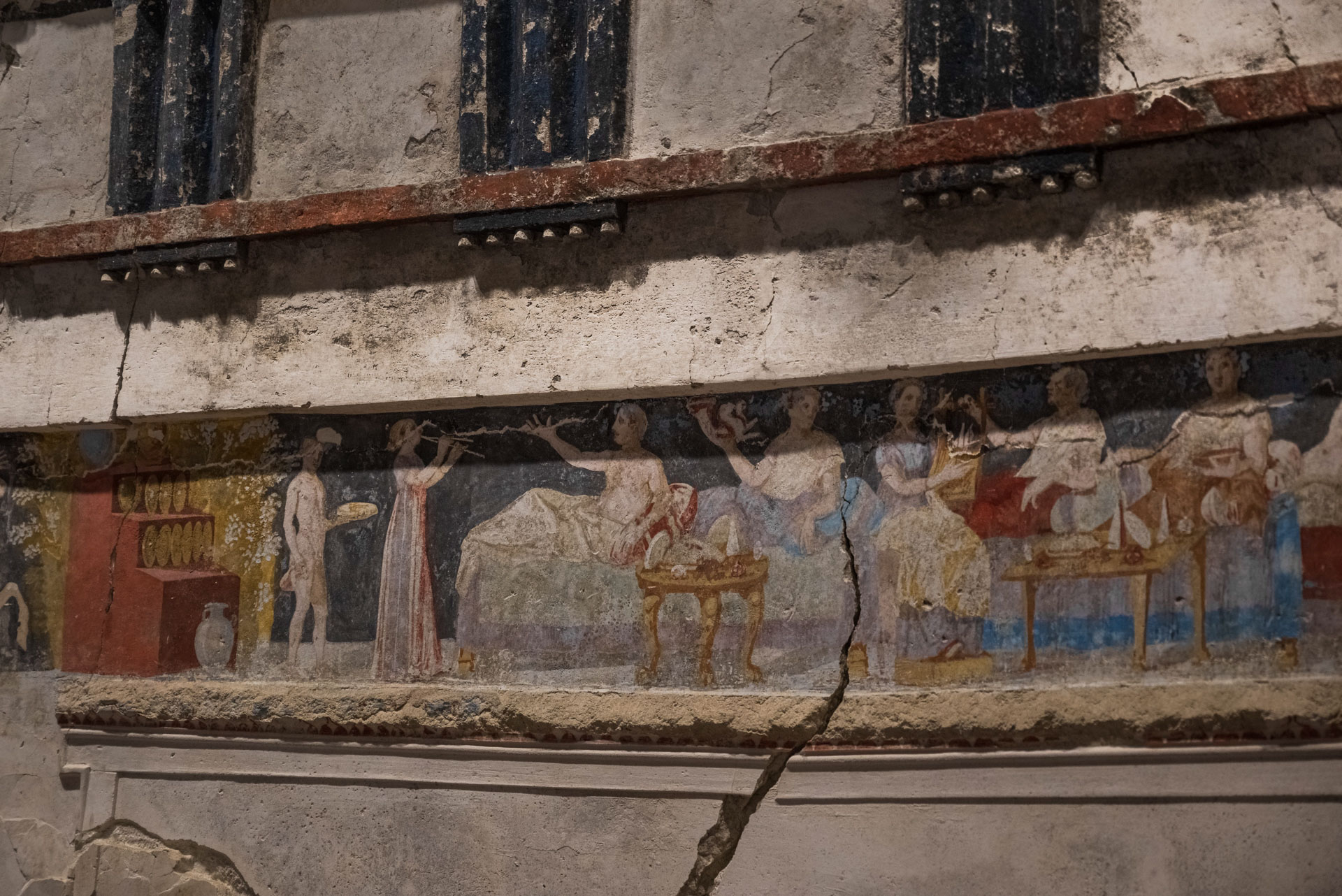
On the left, one can make out the so-called “kylikion,” the piece of furniture on which all the necessary utensils for the banquet are placed (wine mixer pottery, water basin, shallow plates, etc.). Next to it, the young cupbearer stands ready to serve, while the six banquet guests, reclining on their couches, enjoy fine delicacies (pomegranates, grapes, eggs, etc.) and wine.
Although the prevailing view has been that the Macedonians consumed large quantities of undiluted wine compared to the Greeks of southern Greece, various archaeological findings lead us to reconsider this. As Dr. Angeliki Kottaridi explains, the royal banquet vessels found in the tomb of Philip II are much smaller than their Athenian counterparts. According to Macedonian tradition, only those who had managed to hunt a wild boar without using a net during their adolescence had the right to participate in banquets while reclining; otherwise, they stood or sat on a stool (such as King Cassander).
Symposiums in ancient Greece were an institution where men entertained themselves, discussed various topics, and recounted their military exploits. The only women allowed to attend were courtesans and female artists. In this particular case, we see a flutist and a guitarist, lavishly dressed, seated to the host’s left.
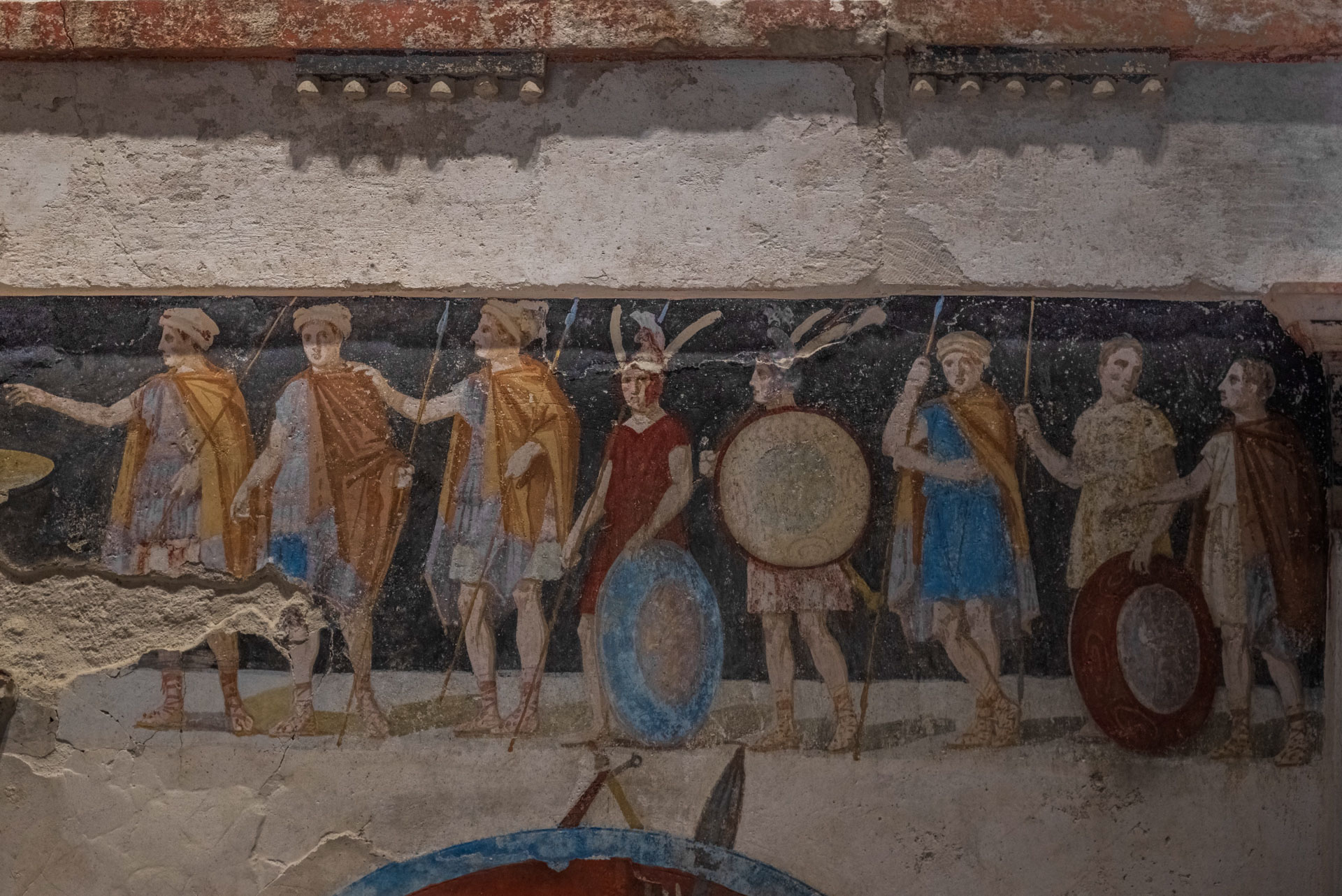
On the right side of the scene, the atmosphere changes completely; everything becomes quieter, and a sense of military camaraderie is evident. A group of eight soldiers arrives to bid farewell to their fallen comrade. Some wear the Macedonian cauldron helmet and others wear helmets, while holding spears and shields. As archaeologist Maria Tsimpidou-Avloniti writes: “…the depiction immortalizes a banquet among comrades-in-arms, in which both the procession of horsemen and the prominent presence of weapons are deeply rooted in aristocratic societies, where these two elements reflect the corresponding heroic ideals.”
To the right and left of the door to the burial chamber, two of the deceased’s comrades-in-arms, painted almost life-size, stand in mourning, leaning on their spears. They wear the “kafsia” on their heads. This traditional Macedonian headdress was a hallmark of Alexander the Great’s soldiers and traveled with them as far as the East, where it survives to this day (known as a pakol in Afghanistan and Pakistan). On their feet are long boots, and their bodies are covered by a heavy chlamys, fastened at the right shoulder. Hanging above their heads are two ceremonial shields: one bears a depiction of a Gorgon (the beautiful type), and the other, Zeus’s winged thunderbolt. They are the eternal guardians of the deceased Macedonian warrior. It is worth noting the painted nails from which the shields hang; they create a perfectly realistic image.
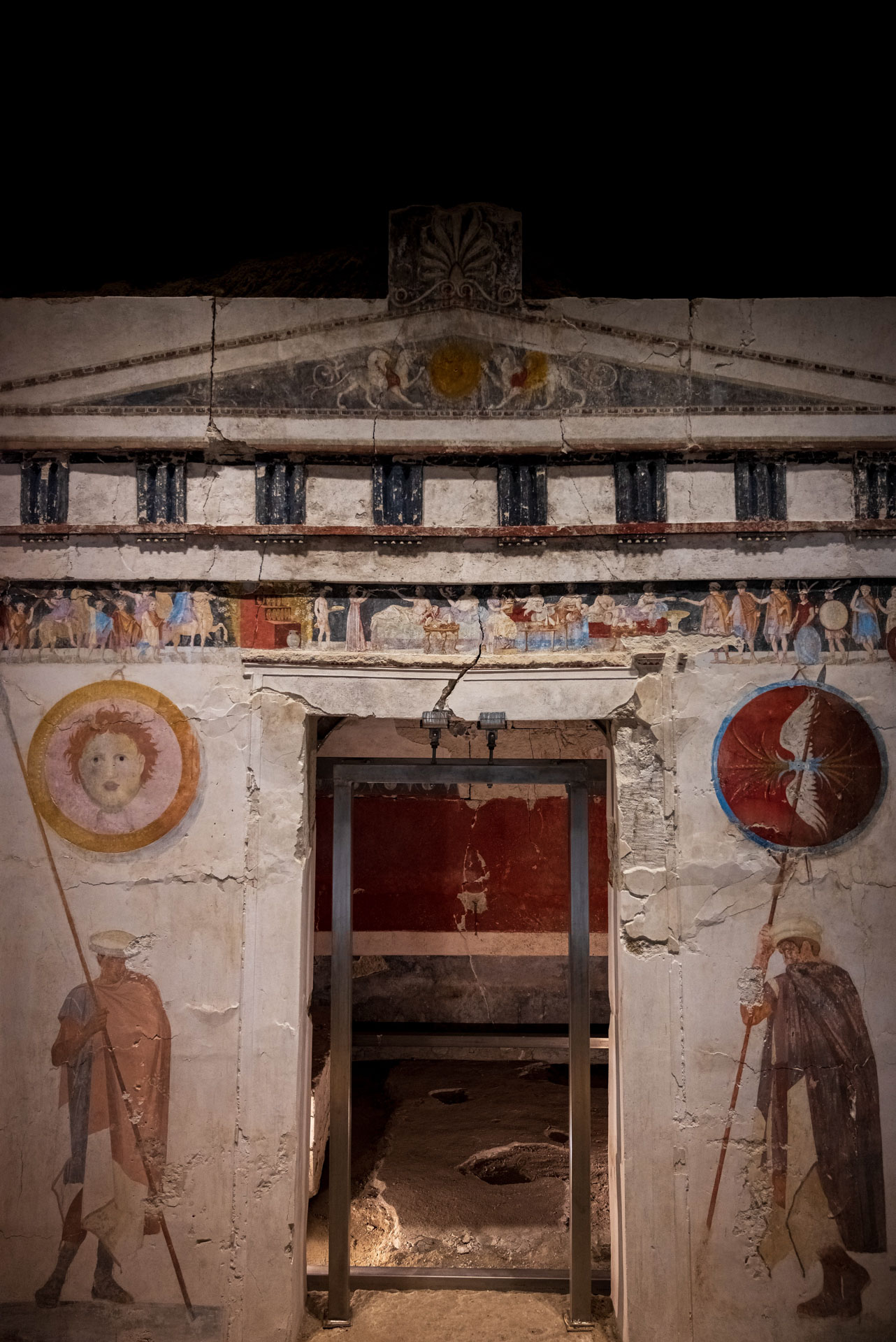
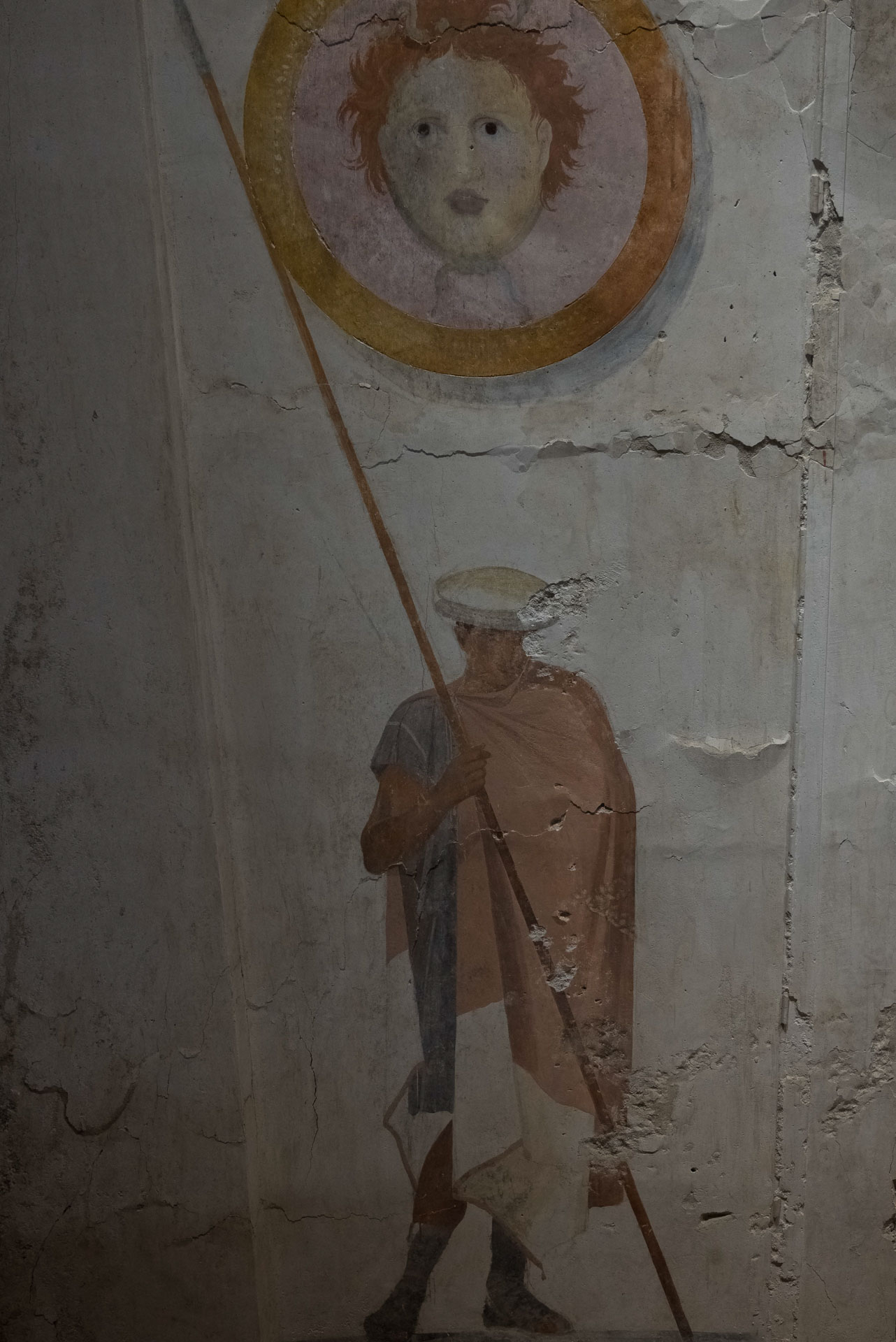
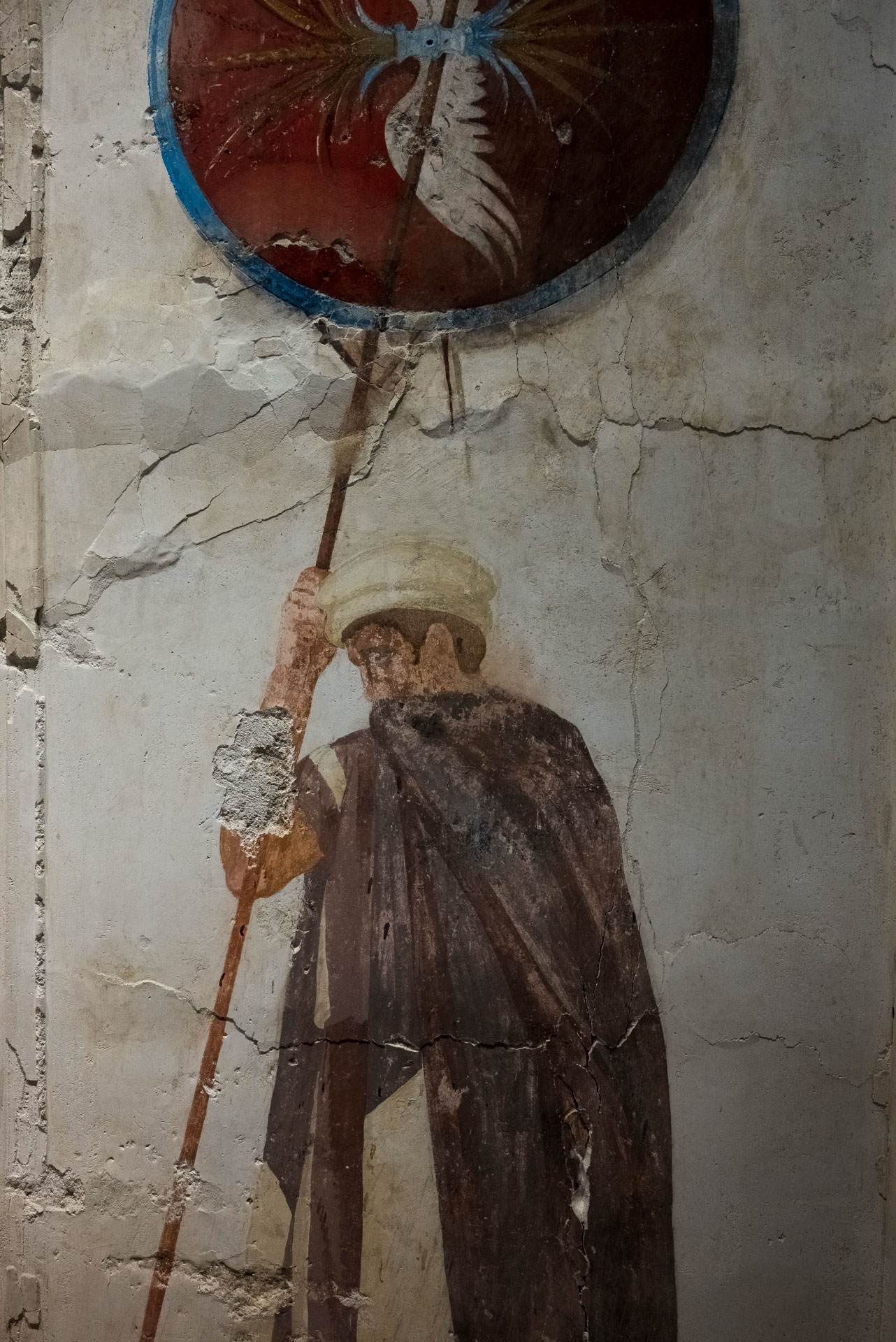
The painter used vibrant pigments, such as brilliant Egyptian blue, deep purple, and golden ochre, lending movement and an almost theatrical quality to the figures, transcending the austere four-color palette of the era. At the same time, special mention should be made of his effort to render the third dimension (perspective)—something that may be taken for granted today but was groundbreaking for antiquity.
The monument’s pictorial representation masterfully balances the joys of earthly life with the melancholy of parting. This is not mere decoration, but a profound reflection on the transition from the intoxication of life to the silence of death. The deceased officer, a likely comrade-in-arms who experienced the grandeur of the Macedonian campaigns, has been immortalized in a unique fresco that speaks to us clearly even today, 2,300 years later.
“…for having led them to Hades through discourse, and having reclined there, and having arranged a banquet of the blessed, they, crowned, spend their entire time already in a state of intoxication, considering eternal intoxication to be the finest reward for virtue…” — Plato (The Republic 363c-d)
- Kottaridi, A. Macedonian Treasures: A Tour of the Museum of the Royal Tombs of Aigai.
- Plantzos, D. Greek Art and Archaeology.
- Plantzos, D. The Art of Painting in the Ancient Greek World.
- Tsimpidou-Avloniti, M. Macedonian Tombs in Phoinikas and Agios Athanasios, Thessaloniki.